Team & Roles
Game Designer
Software and tools
Google Suite (Docs, Sheets, Slides), Adobe Suite (Photoshop, Illustrator)
Context
Personal project to create 2 fanmade factions for the boardgame Root by Leder Games
Duration
3 months as a side project
My work
As a game designer :
- Define the core experience for each faction.
- Analyze existing factions.
- Create and iterate over the mechanics of the factions.
- Playtest each factions in real games against other existing factions, and balance their mechanics to fit a multiplayer competitive game.
- Make the gameplay fit the narrative.
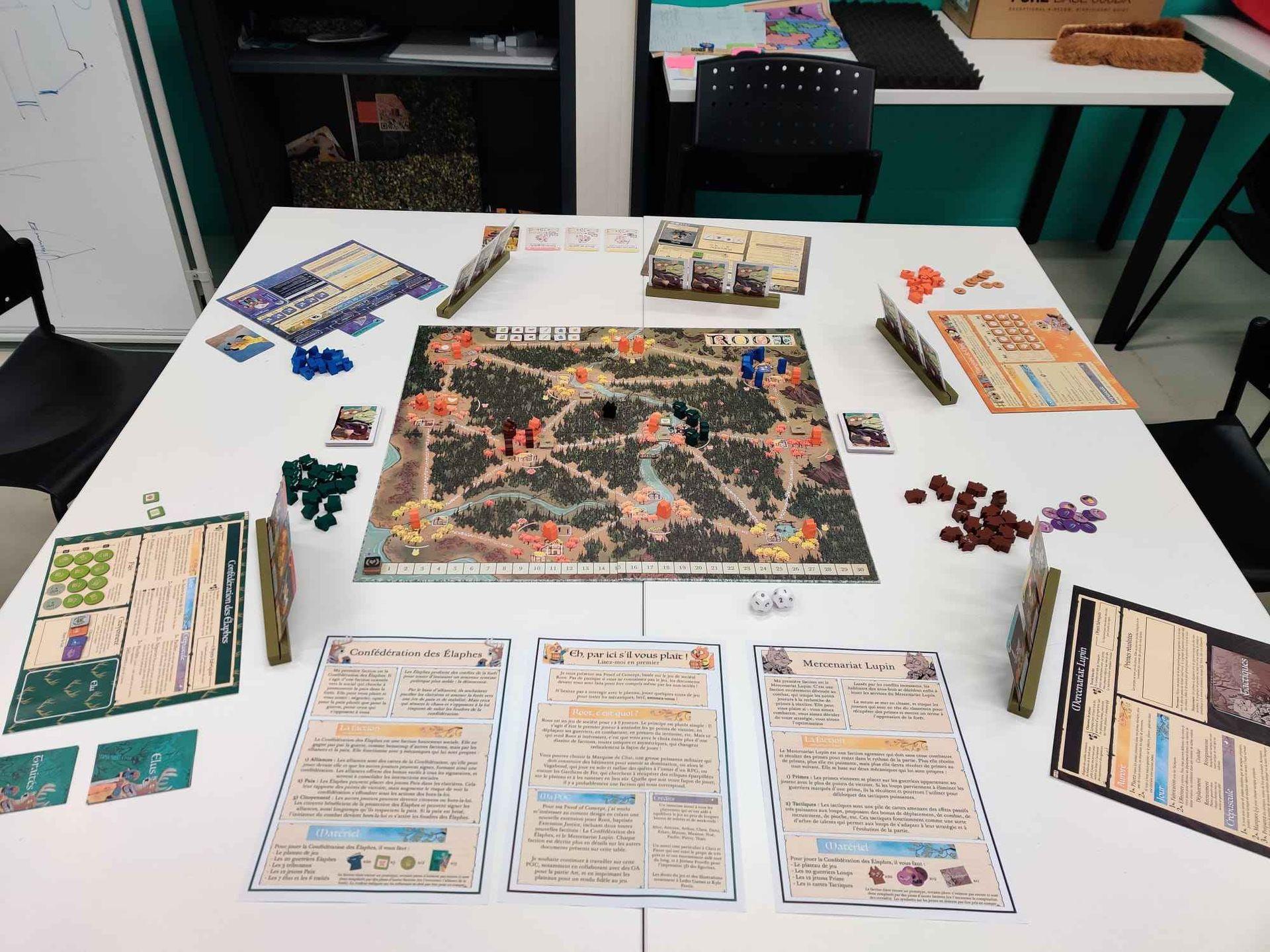
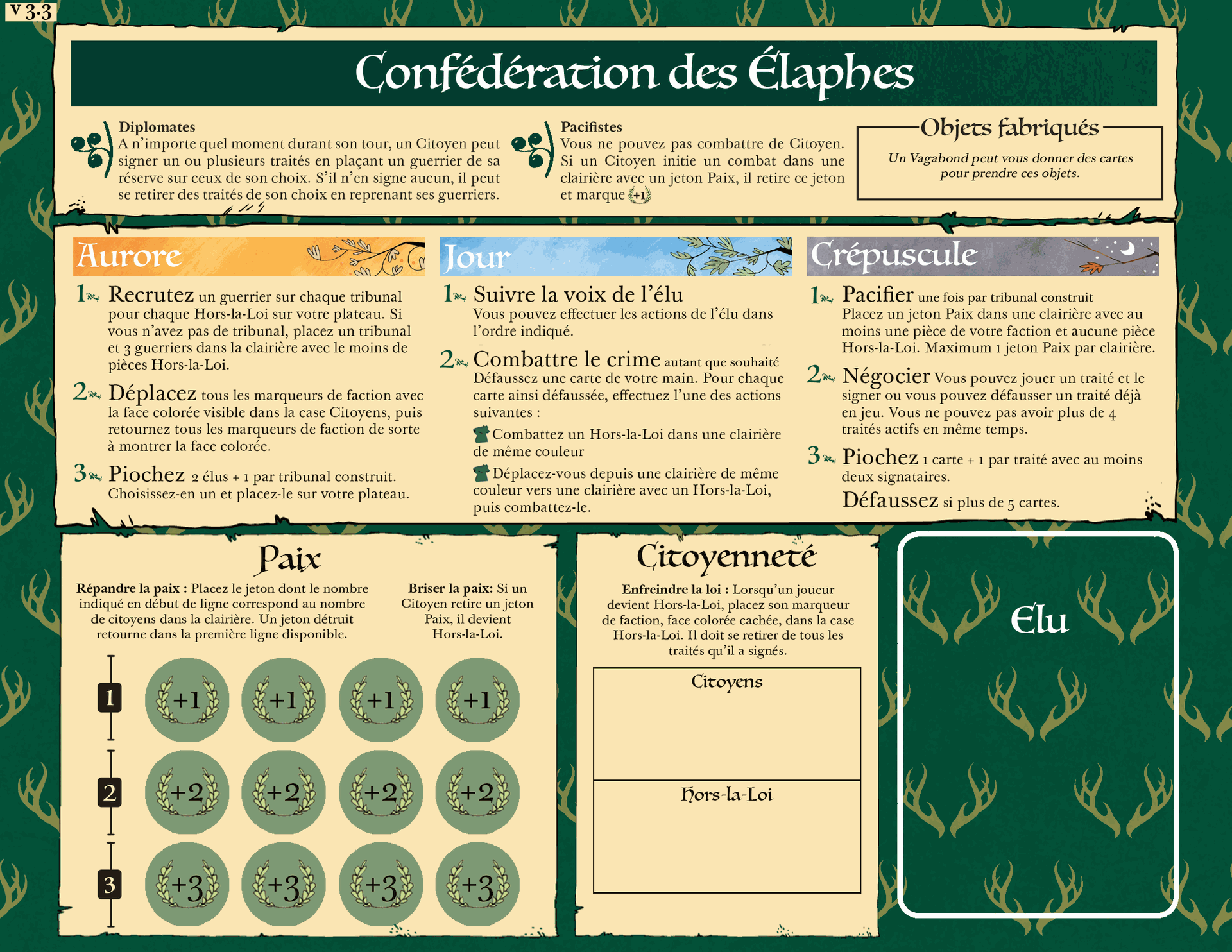
- Create the board for each faction, using Root's existing codes and wordings.
About Root
Root is a board game created by Cole Wehrle with illustrations from Kyle Ferrin, edited by Leder Games (and distributed in France by Matagot). It is an asymetric strategy game, in which each player controls a unique faction with totally different gameplay, and has to fight others to win the control of the woodlands. Players can move their troops to take ground, attack the others, use cards to apply effects or earn points, or use any of their faction's unique abilities.
Root is famous for its asymetrical gameplay. While the Marquise de Cat plays as a classic strategy faction, with a lot of soldiers and economic buildings to maintain, Woodland Alliance shines in guerilla tactics and strong defensive positions, the Riverfolk Company needs to bargain with other players to earn power and victory points, and the Vagabond is not an army but a single miniature completing quests and managing its inventory. With 10 unique factions, Root offers a wide variety of gameplay for all kinds of players.
Genre : Strategy / Competitive
Players : 1-6 (solo mode available against bots)
My process
Before presenting my two factions, I'd like to focus more on my process. To find inspiration and a way to add new content to an already existing game, I had to find new ways to think and work.
With about 3 months to do this work (as a side project), I started with a planning :
- 2 weeks to analyze all the already existing factions, and brainstorm on the factions I wanted to create and some general guidelines.
- 1 month to create and iterate with the core mechanics of each faction.
- 1 month dedicated to playtests, with different players and different factions, iterate and balance.
- 2 weeks to create the additional assets, such as the boards, the tokens, etc. for my school presentation.
I. Analysis
To make my analyze, I could count on my own experience (as I'm a big fan of Root), but also on the community and its tournament stats. With hundreds of games with each faction, it gave me a lot of stats on winrates, strengths and weaknesses. It helped me create a board regrouping factions by difficulty, action economy, board presence, card management and fabrication.
II. Conception
Once I had an overall idea for my two factions, it was time to start digging into concrete mechanics. To be fair, I had some trouble at first to know where to start. That's why I developed a way of brainstorming that proved very useful. I open a blank document and start writing everything I can think of, without any restriction, in short paragraphs (2-3 sentences maximum). As I progress, I highlight my paragraphs with different colors based on their roles :
- New ideas are in green. They appear every time I think about something new, or an iteration of something that I previously wrote.
- Observations are in red. They represent points that I'm not sure of, for example "This idea seems fun but might be very hard to balance" or "There might be too many different mechanics. I should probably cut at least one of them to make it easier and more cohesive".
- Wishes are in blue. They represent things that I want to keep in mind when creating my faction and that I'd really love to keep, for example "I want to keep the fantasy of a faction that works around bounties and contracts" or "I'd like the woods to have a special role".
- Finally, Milestones are in yellow. Whenever I feel like I've made some good changes, I write a milestone that summaries my previous points since the last milestone. It helps me working on the same document over multiple days or weeks, as I just have to read the milestones to have a reminder. It proves also useful when sharing the document to someone else.
This method was really effective, as I was able to write a dozen of pages (6 for each faction) and brainstorm a lot by myself, while keeping a track of all my thoughts. It is also really helpful against the "blank page syndrome" as I don't have to prevent myself from writing anything that I have in mind.
III. Playtests and iterations
Finally, the most difficult part was by far the playtests and iterations phase. As Root is a very long board game, it was difficult to gather players every week or so to play for multiple hours while trying new factions, explaining new rules, and so on.
In a month, I was able to do 9 playtests (5 for a faction, 4 for another). This was clearly not enough to create a perfectly balanced faction, as I could not even try it against every other faction, but it certainly helped me finding what had to be adjusted, removed or reworked.
The factions changed a lot between each playtests, with major reworks for some of their core mechanics. After each playtest, I noted the score of each player, with a summary of all the feedbacks and notes from me and the other players, then added a list of changes and decisions taken after the playtest (like the systems that had to be reworked, some balancing fixes, etc.).
Faction #1 - The Confederation of the Elaphs
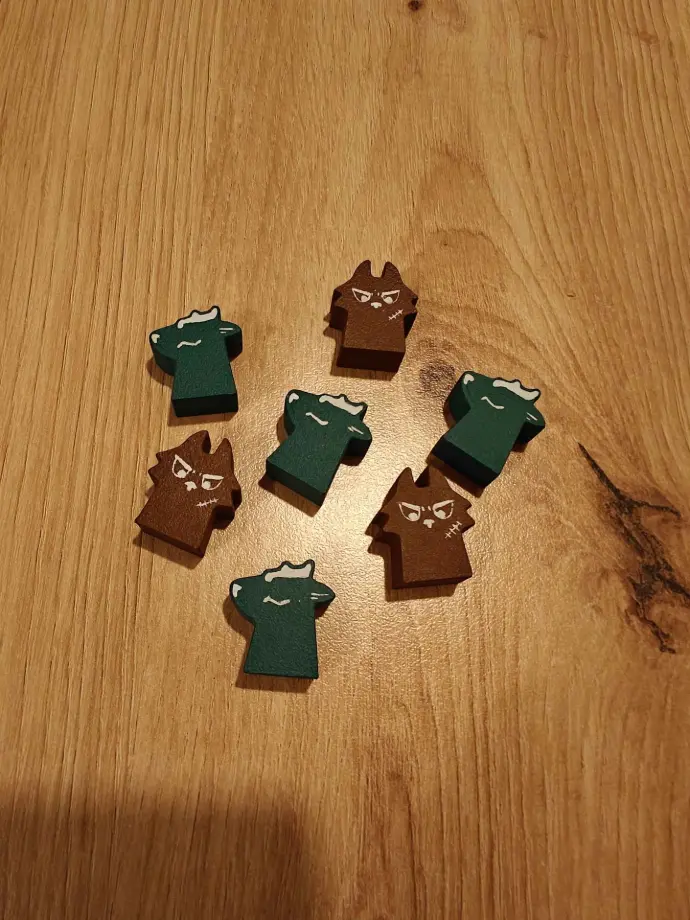
The Elaphs are a highly social faction, inspired by the Riverfolk Company. I wanted to emphasize the noble aspect of the deers by creating a faction that needs to maintain peace and add some sort of democracy across the table.
The Elaphs uses 3 uniques abilities :
- Alliances : The Elaphs can place Alliance cards in front of them. Other players can sign any alliance, forming a Confederation and earning various bonuses that benefit everyone... as long as the truce is maintained.
- Peace : The Elaphs win victory points by placing Peace tokens in the clearings. This consolidates the peace, but puting too much Peace tokens enhances the risk of having outlaws breaking it. The Elaphs have to find a balance between scaling their territory and maintaining a small but ordered area.
- Citizens : Other players become Citizens or Outlaws, depending on their actions. Citizens are protected by the Elaphs and benefit from the alliances, but they are restricted in their actions are they have to avoid breaking the law. Outlaws are free, but can be attacked by the Elaphs and can not benefit from the alliances.
Strengths :
- Alliances : Alliances are powerful and should help you bargain with others. The more of them you have, the faster you can spread your Peace tokens and earn victory points.
- Team-playing : It is not in their advantage for any player to become an outlaw, as they indirectly become enemies of the whole alliance. Elaphs also have very strong attacks against outlaws. Just like the otters, Elaphs benefit from the teamplay aspect : if one player teams up with the elaphs, he wins. If all players team up with the Elaphs, the Elaphs win.
Weaknesses :
- Action economy : The action economy of the Elaphs is very weak, and depends on the Elected Deers that are chosen each turn. You need to have emergency plans if your cards are not drawn in a good order.
- Limited by the law : Unless other players, who can become outlaws, Elaphs can never break the law. Most notably, it means you cannot attack a citizen. So if another player starts winning, but always stays under the law, you have virtually no way to prevent it.
Versions : 10, with 3 major ones (v1, v2, v3) and 7 small ones
Playtests : 5
Played against : 9 out of 10 factions
Faction #2 - The Lupine Mercenaries
The Wolves are an extremely aggressive, all-in faction, specialized in hunting and killing targeted enemies. I wanted to create a kingslayer-oriented faction, based on bounties and balancing the game between players.
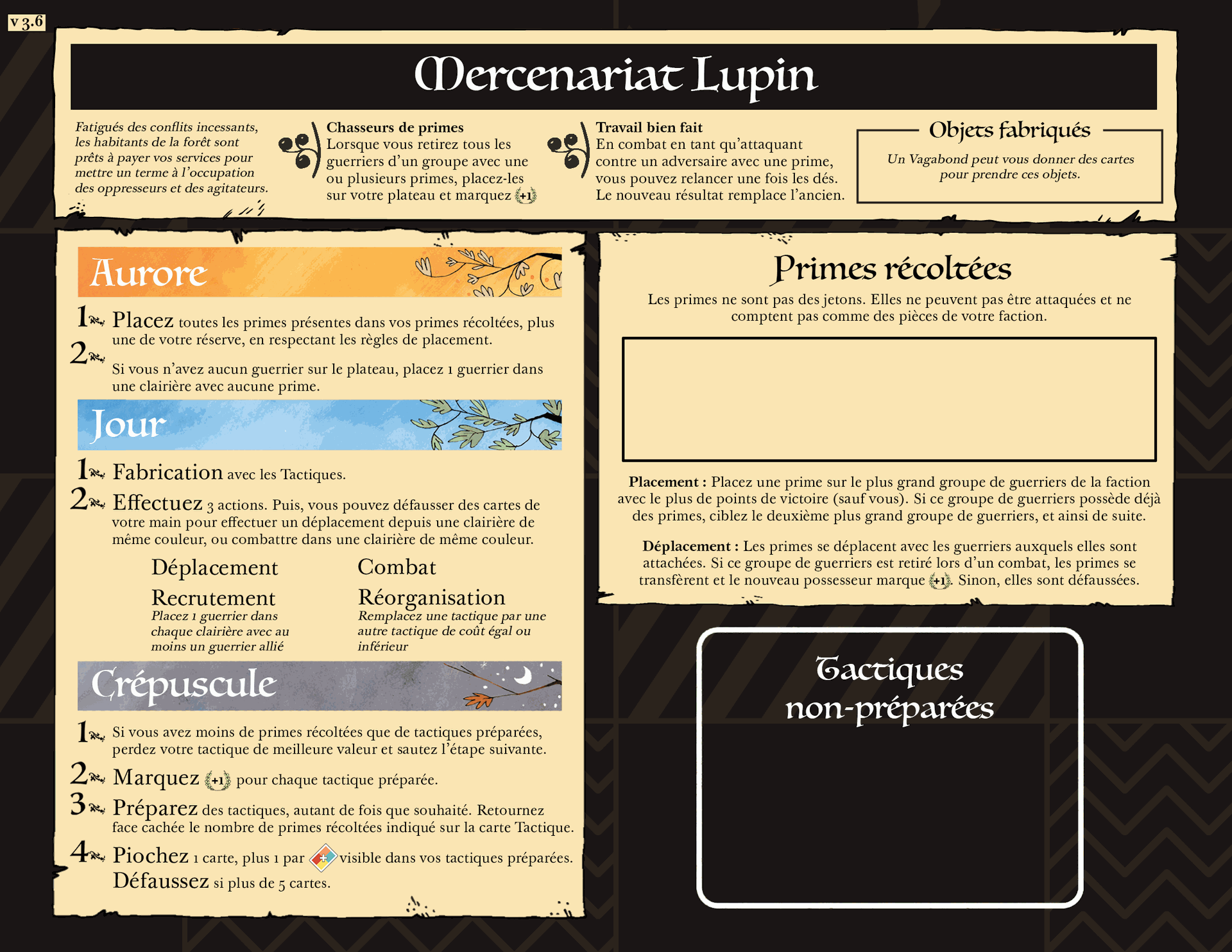
The Lupine Mercenaries use 2 uniques abilities :
- Bounties : Bounties are placed on the biggest groups of enemies of the player who is leading the score. They serve as the main victory condition for the Wolves, while giving them significant bonuses, such as a free dice reroll against these enemies.
- Tactics : As Wolves collect bounties, they unlock new tactics that give them new uniques bonuses, such as more mobility, better chances to land their hit, more recruitement, etc.
Strengths :
- Tactics : The major strength of the Wolves comes from their tactics. With 11 tactics to choose between, the player can adapt its strategy to any situation and create powerful skill combinations. This makes the Wolves one, if not the best, faction in attack.
- Not an interesting target : Similar to the Vagabond, the Wolves do not build anything on the board. This means that attacking them is only useful for slowing them, but do not reward with any sort of victory points. This makes the wolves a bad target for all the other players, compensating for their lack of defensive options.
Weaknesses :
- Predictible : As your bounties are visible to everyone, your actions are very predictible and players can easily avoid your attacks by moving their troups. For example, moving the cats towards the keep is a very effective way of preventing wolves to collect their bounty.
- Kingslayer : Bounties are placed automatically. Since the wolves need to collect enough bounties each round to keep their economy running, they can not choose their target freely and almost always have to go for the leader. This can lead to difficult situations where the leader in terms of victory points is not the most dangerous player at that time.
Versions : 15, with 3 major ones (v1, v2, v3) and 12 small ones
Playtests : 4Played against : 6 out of 10 factions
Fun Fact
Shortly after I finished this project, Cole Wehrle announced its next expansion for Root : The Homeland Expansion, with three new factions. Although their exact mechanics are not very explicit yet, two of them seem close to mine. Here are their official descriptions, taken from their kickstarter.
- Sickened by the enduring conflict, the Twilight Council hosts assemblies to end the war, bringing together all the Woodland from the lowliest mouse-in-a-sack to the mightiest hawk with a royal claim. The assemblies emphasize political connections over pure numbers of warriors, pushing the factions away from bloody battle and toward heated debate.
-
Nobody really knows how the Knaves of the Deepwood got together, but the myths are many. From the treeline these miscreants and ne’er-do-wells sally forth, raiding barracks and baggage trains and making off with warriors in tow as hostages. Why? For ransom, that’s why. Some say they give the proceeds to the needy. Some say they spend it lavishly.